Interview with Solenne Ojea-Devys (MSc Entrepreneurship 2010), Chief Executive Officer of OKKO HOTELS

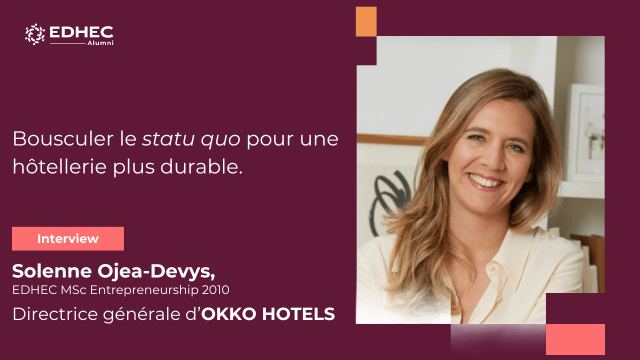
With OKKO HOTELS, which she has been leading since the end of 2021, Solenne Ojea-Devys (MSc Entrepreneurship & Innovation, 2010) is redefining the role of SMEs in the hospitality sector and challenging the status quo through a driving CSR policy and mission-driven company status. She shares the commitments and convictions that accompanied the opening of the first 15 OKKO hotels and will shape the group’s expansion in the years to come, through a reflection on new travel trends.
How would you summarise your role and current responsibilities?
My job is that of a captain: setting a course, recruiting the right people on board, motivating teams on a daily basis, and ensuring that everyone has the means to do their job properly, all within a positive atmosphere. The captain also identifies risks and opportunities, sometimes goes a little beyond the planned route, and must understand their environment. And on land, like in most SMEs, it is also the person who shakes every hand. I am indeed the company’s first salesperson, both to investors and potential clients. I have built up a strong network of peers in the industry, with whom I enjoy exchanging regularly in order to develop my view of the market.
In 2014, the first three OKKO hotels opened in Nantes, Grenoble and Lyon. How did you select these destinations and apply the OKKO concept there?
Geographical development in hospitality, for a group like ours, is a mix of strategy and opportunity. The City of Nantes wanted to give a different tourism image to the destination at the time of the creation of Le Voyage à Nantes (Editor’s note: the name of Nantes’ tourist office and a summer event). To roll out the concept, I needed the brand to be extremely strong from the outset, as it was being deployed on a much smaller scale than major groups. To go as far as possible in terms of consistency, I was very demanding with the teams. They could not even choose an umbrella stand without my approval! What I learned is that beyond décor and atmosphere, people come back for the quality of the welcome. We spent a lot of time defining what would make it different at OKKO. With 85% satisfaction across the group and 91% on the welcome criterion, this is, for me, OKKO’s greatest success. We work extensively on design, but also on the way we welcome guests and on what they perceive through their senses (fragrance, materials, food).
The opening of the OKKO hotel in Troyes in June 2025 is part of the regeneration of the station district. How do you work with cities?
We work hand in hand with local territories, either directly with mayors and their teams or with destination marketing agencies. We collaborate extensively with SNCF and railway stations, as these are always ultra-central and strategic locations. In France, these areas long suffered from a poor image. Yet they are now being renovated one after another. Guests travelling to our hotels account for 80% of our carbon footprint. The hotel operation itself represents only 20%. It is therefore essential for us to be located within a 15-minute walk of an SNCF station, a metro, RER or tram stop. Our hotel in Gare de l’Est in Paris is one of our greatest commercial successes. This completely ambitious project took us seven years, given the administrative and technical complexity of creating a hotel inside a railway station, above a metro and RER hub.
Today, your 15 hotels are all located in France. How will the next phase unfold?
International development, primarily in Europe, will be carried out mainly through direct ownership rather than franchising, as we are determined to preserve brand standards, execution quality and the company culture we have built. We could have opened twice as many OKKO hotels, but we wanted our locations and projects to fully reflect our original positioning. Being a mission-driven company is essential for us, as it aligns with our values and our competitiveness. Climate and social challenges will only intensify in the coming years. The tourism sector is particularly exposed: it represents 7% of GDP in France and 11% of greenhouse gas emissions. In addition, our professions struggle to recruit – around 200,000 positions are considered vacant in hospitality and food service – and to retain talent. Mission-driven company status enables us to attract people and keep them.
OKKO HOTELS was also among the first to address CSR issues in the hospitality sector, which still seems rather cautious…
The sector remains very traditional. Like many companies, hoteliers fear that change will be costly and complex, and that it may face resistance from teams and customers. At OKKO HOTELS, CSR is not a marketing positioning; it is anything but greenwashing or social washing. When you remove all the small things that customers have been (wrongly) conditioned to expect, the question becomes what you offer in return – and this is where hoteliers sometimes lack creativity. Instead of plastic bottles and minibars in rooms, we install water fountains in shared spaces, where tea, coffee, cakes and fresh fruit are available at all times and included in the room rate. At a cost of just €1 per guest, we generate satisfaction. You have to dare to test things with customers. The freedom we give them in shared spaces makes them feel more comfortable. They share an experience while respecting each other’s boundaries. This concept is particularly appreciated by women travelling alone.
This is the exact opposite of chain hotels…
Chain hotels have become so standardised that you no longer know whether you wake up in Seoul, Montpellier or London. Everywhere, it is the same laminate colour, the same bar of soap, the same plastic cup wrapped in blister packaging. In the early 2010s, guests began spending more time in bed and breakfasts and guesthouses, and then Airbnb arrived. People were even willing to stay in someone else’s home to find authenticity. This paved the way for the emergence of lifestyle hospitality, inspired by ways of living and offering richer experiences. OKKO HOTELS emerged within this movement. Alongside other European players, we shared the same conviction but offered different answers. Today, people no longer go to hotels solely for business trips. They go for team-building with colleagues, for a coffee, a client meeting, a family brunch, a date, or a dinner as a couple.
What have been the most recent developments in the hospitality sector?
Over the past 15 years, outdoor hospitality has undergone significant transformation. Camping, once considered outdated, is making a strong comeback, driven by society’s growing need for nature. There is also a new trend for countryside hotels located an hour from cities, accessible to families, seminar offerings combining nature and culture, and the renewal of urban hospitality through staycations – staying in a hotel in one’s own city. Hotels must seriously rethink uses beyond overnight stays, as most are almost empty between 9.30 am and 5.30 pm. This is also a way to convince local authorities, mayors and urban planners. Office hotels designed solely for transient guests no longer appeal to them. I am convinced that we are moving towards greater hybridity and modularity in room usage, perhaps one day with floors dedicated to medium-term stays alongside rooms rented by the night.
Is the future of tourism about slowing down?
I believe travel will never disappear. Discovering other cultures is a fundamental human need. Globally, the primary reasons for travel are religious and family-related, not professional. I sincerely hope that we will adopt more thoughtful ways of travelling: when going far away, staying longer; not being mere consumers; learning to travel closer to home within a slow tourism approach. That said, holidaying in France remains extremely expensive. A week of outdoor camping can sometimes cost the same as a week in a holiday club in southern Europe, flights included. There is still a great deal of work to be done on the offer to make more responsible tourism accessible to as many people as possible.
What was your intention in co-founding the Climate House with entrepreneurs from all sectors?
The objective was to create a resource hub where everyone interested in the climate transition could come together, whatever their level of knowledge. It is a fascinating ecosystem bringing together start-ups, funds, entrepreneurs, activists, scientists and public figures engaged in these issues, within a space that is both a co-working hub, office space and event venue. There are working groups on specific topics and tailored programmes for companies that need support and training, to raise awareness among their teams and create action plans. In tourism, things do not move very fast, and that can sometimes feel discouraging. I needed to exchange with others who see the glass half full. It is a source of comfort and motivation.
How do EDHEC’s commitments to Net Positive Business resonate with your convictions and the vision you wish to promote in the hospitality sector?
This approach seems fundamental to me. If tourism does not reinvent itself, it will disappear. The same applies to business schools. For many young people, the desire to contribute through their professional lives not only to growth but to progress – and to finding concrete solutions to climate and social challenges – has become vital. I am delighted that EDHEC is providing a concrete response to these aspirations, which represent our future.

Comments0
Please log in to see or add a comment
Suggested Articles