Interview with Nicolas Ploquin (EDHEC Master 1996), CEO of Acteon Group

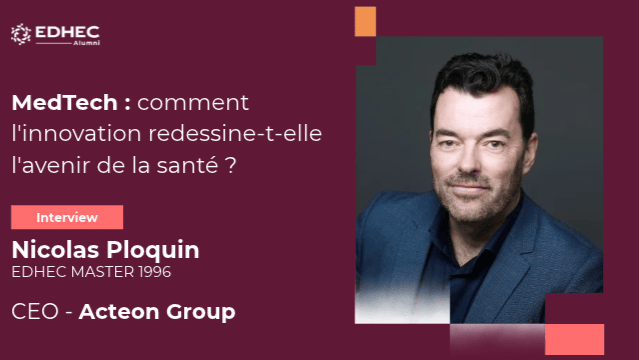
Over 22 years in healthcare, Nicolas Ploquin has worked across a wide range of specialties, from ophthalmology, clinical diagnostics, radiology and oncology to, more recently, dentistry. At Acteon Group, one of the leading players in dental MedTech, he oversees the development and distribution of pharmaceutical products, anaesthetics, imaging solutions, dental equipment and hand instruments for dental professionals in more than 120 countries. Driven by a strong belief in the positive impact businesses can have on society, he shares his perspective on a globalised, highly competitive industry in which European players like himself are determined to hold their own.
What role does MedTech play in the healthcare sector?
MedTech offers an alternative to pharmaceutical treatments and can often be significantly more effective. It provides healthcare systems with another valuable set of solutions. For example, vision problems can be addressed with glasses (optical correction) or contact lenses (MedTech). Cardiac arrhythmia can be managed either through lifelong medication, which may have potential side effects on the kidneys, or through a surgical procedure involving the ablation of certain tissues around the heart.
MedTech can also serve more aesthetic purposes, such as dental implants and clear aligners, or address medical needs through devices such as prostheses and heart valves. It is an incredibly broad field, with constant innovation and increasingly intelligent medical devices. Healthcare systems are facing growing demand as the global population ages, while the number of healthcare professionals is not increasing at the same rate. It is therefore essential to develop MedTech solutions that help clinicians save time.
Are pharmaceutical products gradually being replaced by MedTech?
Not at all. The two fields coexist and complement each other. There is continuous innovation in pharmaceuticals, particularly in cancer treatment, with targeted and personalised approaches such as immunotherapy and treatments tailored to a patient's genetic profile.
At the same time, radiotherapy offers another form of targeted intervention within MedTech. These approaches are not mutually exclusive. I believe healthcare professionals have a crucial role to play in keeping up with developments, fully understanding each patient's clinical situation and making the most appropriate choice between pharmaceutical and MedTech solutions.
At Acteon Group, for example, two-thirds of our business is focused on MedTech, while the remaining third consists of pharmaceutical solutions, including anaesthetics.
Can a highly promising technology fail because healthcare professionals are reluctant to adopt it?
Absolutely, as is often the case in professions shaped by established routines. Doctors learn specific techniques during their training, and once they begin practising, they develop habits that can be difficult to change. When introducing a new technology to the market, it is therefore essential to invest considerable time in training. Sales representatives are naturally an important communication channel. However, we cannot visit the world's 2.5 million dentists every day, so we also rely on partners, often universities. People are willing to change their habits when an innovation genuinely addresses an existing need. Doctolib, for example, has transformed the way healthcare professionals work while meeting a real patient need: finding an appointment at short notice in their local area. We follow the same principle. We develop solutions that enable dentists to work more efficiently, particularly in procedures such as air polishing and scaling. We organise a large number of hands-on training sessions, almost daily in France, take part in round-table discussions and maintain a strong online presence. Our Acteon Academy training programme offers a wide range of courses, and we regularly attend dental congresses to showcase our latest innovations.
How does Acteon Group differentiate itself in such a competitive market?
The market is highly competitive worldwide, and we face specialist competitors across each of Acteon Group's three areas of expertise. The key is to stay close to our customers, spend time with dentists and understand their everyday clinical practices. Acteon Group remains a medium-sized MedTech company, with a turnover of €250 million, competing against businesses generating several billion euros in revenue. Once we have identified our customers' needs, our product management, marketing and research and development (R&D) teams take over. Our R&D team comprises 70 engineers developing tomorrow's products, and we have built a portfolio of 391 patents. We carefully select the projects that will create long-term value for the business and invest accordingly. Our R&D budget represents around 5% of our turnover, with more than 30 projects currently under way. We have three production facilities in France, manufacturing dental equipment and pharmaceutical products in Bordeaux and dental instruments in Auvergne. Our imaging solutions are developed near Milan. We therefore maintain strong local roots.
Does Europe have the ambition to support MedTech companies in competing with Chinese and American giants?
Europe has excellent talent and considerable expertise in dentistry.
However, our regulatory framework, particularly the Medical Device Regulation (MDR), which is considered one of the strictest in the world, can present challenges, as bringing products to market may take longer than in Asia or the United States. We are therefore working with public authorities to raise awareness of the need to simplify regulatory procedures while safeguarding the competitiveness of European industry. In France, for example, some public tenders are awarded primarily on price. We believe it would be fairer to place greater emphasis on quality, innovation and regulatory compliance, ensuring a more level playing field between European and international competitors.
How does this translate into Acteon Group's day-to-day operations?
Our teams must constantly stay up to date with regulations in every country where we operate, as well as in Europe, where our manufacturing facilities are located. Our significant operations in the United States and China are therefore also affected by European regulations, with the EU AI Act being just one example. While our medium size can make it challenging to compete globally, it also gives us greater agility than companies generating several billion euros in revenue. Our ability to respond quickly is fundamental.
Today, our solutions are designed to integrate seamlessly into dentists' everyday clinical workflows. Despite all the current discussion surrounding AI and technology, we firmly believe that our solutions should enable dentists to devote as much time as possible to the human side of their profession. There is still progress to be made, particularly as many patients remain anxious about visiting the dentist!
Our teams need to reflect this philosophy. That is also why I have recruited extensively since joining the company, including the recent appointments of a Chief Innovation Officer, an HR Director and a Marketing Director. I wanted to build a management team capable of supporting our growth and reflecting the company's ambitions. More and more business school graduates are entering the MedTech sector.
Is it better to launch a business alongside someone with a medical background?
MedTech always starts with a healthcare problem or a clinical need.
It is therefore essential to invest time in understanding the science and the challenges involved, taking an approach that is, in some ways, similar to marketing. This means spending time alongside doctors and specialist healthcare professionals, sometimes engaging in highly technical discussions. That is why the combination of medical and business expertise is crucial in start-ups.
Business school graduates absolutely have a place in this industry, but they need to demonstrate humility and a willingness to listen. It is also important to understand that development cycles in healthcare can be longer, and the responsibility associated with decision-making is greater because people's lives are at stake. Working in healthcare is so meaningful that I would not want to return to another industry today. Healthcare professionals and business professionals are driven by different motivations. Understanding and embracing this dual perspective is essential in an industry that invests and innovates to improve patients' lives.
What advice would you give to a young EDHEC graduate interested in MedTech?
For me, curiosity is central to leadership.
Many of my ideas come to me when I am running, watching a film or reading a book. You should never have preconceived ideas about your career path. It is important to take an interest in other people and explore different industries. Today, with AI, there is increasing crossover between many sectors. I still believe that sales is an excellent learning experience. In MedTech, starting your career in a sales role that involves working closely with doctors can be a particularly valuable way to gain a practical understanding of healthcare professionals, their clinical practices, patients and the wider healthcare ecosystem. The changes currently taking place across healthcare can be incredibly exciting for entrepreneurs.
It has also become essential to develop an international outlook. Personally, I have spent more than 70% of the past 25 years abroad, and 90% of Acteon Group's turnover is generated outside France. Today, our main growth opportunities lie in international markets, particularly in Asia and Latin America.

Comments0
Please log in to see or add a comment
Suggested Articles