
Interview with Gökhan Isparta (MSc 2005), Managing Director at CMA CGM Türkiye

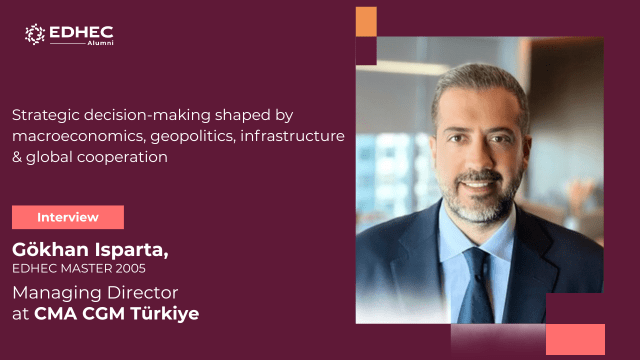
With nearly 20 years of experience in the shipping industry since graduating from EDHEC Business School, Gökhan Isparta is the Managing Director of CMA CGM in Türkiye. He shares how decision-making in a strategic sector is shaped by macroeconomics, geopolitics, infrastructure, and international cooperation, while keeping service continuity, customer needs, and sustainability at the core.
How would you summarise your role and current responsibilities?
My role is to translate CMA CGM’s global strategy into concrete, actionable plans for the Turkish market, and to drive the commercial development and growth of our services and solutions in Türkiye. This covers the full commercial lifecycle, from business development and customer relationships to after-sales support and operational execution.
Alongside this, I oversee end-to-end operational activities, including customer service, shipment planning, and close coordination with operations to ensure safe and efficient loading and discharge. Having this holistic view allows us to align commercial ambition with operational excellence and customer satisfaction.
I lead an organisation of around 250 people across three strategic locations in Türkiye: Istanbul, our main commercial hub, as well as Izmir and Mersin. Developing people is one of my key priorities. I strongly believe in building a culture of continuous learning, where teams grow their skills, broaden their perspectives, and feel empowered to contribute meaningfully to the company’s long-term success.
Does your field cover everything that actually enters, leaves, and goes through Türkiye?
Yes. Türkiye’s geographic position makes it a natural logistics hub. We manage a broad range of import, export, and transit flows, including transshipment activities that connect Türkiye to surrounding regions such as the Eastern Mediterranean, the Black Sea, and parts of the Middle East.
Our scope covers not only containerised cargo moving in and out of the country, but also cargo passing through Türkiye as part of wider regional supply chains. For example, some cargoes arriving by sea are redistributed to neighbouring markets, while others move inland toward Europe or Central Asia.
We increasingly rely on multimodal solutions when they are operationally and environmentally relevant. Rail connections, where infrastructure allows, play an important role in reducing emissions and improving reliability. Road transport remains essential for flexibility, especially for last-mile delivery. All these solutions are structured around an ocean leg, which remains the backbone of global trade in terms of scale and efficiency.
How will the “New Silk Road” project — from the modernised Faw Grand Port in Iraq to Europe through Türkiye by rail — impact the shipping industry in the next few years?
Several alternative corridors like this are currently being developed. Their real impact will largely depend on rail and road capacity, as ocean shipping remains far more scalable for global trade.
That said, these corridors can complement existing supply chains. In some cases, they may offer faster transit times; in others, they may be better suited to specific cargo types that require different handling or routing. From a sustainability perspective, solutions that combine ocean and rail transport can also offer advantages compared with road-only options, depending on how the corridor is designed and operated.
How do you strategically make decisions between serving CMA CGM Türkiye’s interests and the Group’s global interests?
We operate within clear strategic frameworks while constantly adapting to changes in geopolitics, macroeconomics, and infrastructure. Türkiye is a large, dynamic economy and a key market in the Mediterranean region, so the challenge is to grow responsibly while remaining fully aligned with the Group’s overall priorities.
When decisions are complex, I turn to CMA CGM’s core values — boldness, excellence, exemplarity, and imagination — as a compass. They help guide choices that are right for our customers, our employees, and the company. At the same time, we actively contribute to the Group’s decarbonisation ambition through operational optimisation, the progressive use of alternative fuels, and customer solutions such as ACT+, which supports shipment decarbonisation and provides verified documentation aligned with recognised standards.
How do you cope with changes that can occur in international agreements?
Over the last few years, volatility has clearly increased, and conditions can change very quickly. We remain attentive to developments, stay open to information, and adapt our network and operations whenever necessary.
Our priority is always continuity for our customers. When disruptions occur in certain corridors, we adjust routing and execution to maintain reliable service. These adaptations can create constraints and added complexity, but supply chains are inherently dynamic, and our role is to provide resilience, flexibility, and solutions.
Maritime trade relies on a small number of critical chokepoints. The Bab el-Mandeb Strait, which connects the Red Sea to the Indian Ocean, is one of the main gateways between Asia and Europe via the Suez Canal. When traffic through this area is disrupted, vessels reroute around the Cape of Good Hope, at the southern tip of Africa.
This alternative route adds significant sailing distance and time, which has direct implications for schedules, fuel consumption, and fleet deployment. It also affects port congestion and equipment availability across multiple regions.
These examples illustrate how geography, geopolitics, and logistics are deeply interconnected.
Can the set of international tariffs — such as those recently discussed for the United States — change the whole route organisation?
Trade policy decisions can influence routing, demand patterns, and planning, especially when announcements create uncertainty for exporters and importers. In practice, reactions vary depending on factors such as inventory levels, contractual commitments, and how quickly measures are clarified through dialogue.
In shipping, uncertainty and macroeconomic shifts regularly affect volumes and flows. However, the fundamentals remain unchanged: global supply and demand ultimately drive trade. Our responsibility is to keep networks robust and to support customers with continuity and dependable options as conditions evolve.
Can the market still extend given all infrastructure limitations on ports and roads?
Yes, the market can continue to grow, but terminal capacity and hinterland connectivity will require sustained attention over the long term. In several regions, port and landside infrastructure are becoming bottlenecks to trade growth.
If investment does not keep pace, operating models and network designs will need to evolve — through better planning, different vessel deployments on some routes, and stronger intermodal connections. Shipping can still achieve scale, but long-term growth in global trade ultimately depends on continued investment in ports, terminals, and inland infrastructure.
Are there any ongoing changes in world trade that could significantly impact international shipping in the coming years?
Beyond infrastructure, one of the most significant transformations is AI and digitalisation. At CMA CGM, our approach is very much human-centric: we use AI to support our teams, enhance customer experience, and optimise operations. This aligns with the vision shared by our Chairman and CEO, Rodolphe Saadé.
We are already advancing automation and digital processes, strengthening end-to-end visibility, and exploring more advanced AI capabilities to improve reliability, efficiency, and service quality. The full scale of AI’s impact will unfold over time, but we are not just observing this change; we are actively shaping it.

Comments0
Please log in to see or add a comment
Suggested Articles